Trusted by 1 million+ Consumers


Top Personal Finance Trends for 2026: How Money Moves, Saves & Grows for Indian Freelancers in a Digital Age
Manage irregular freelance income, navigate UPI, optimize taxes, and scale earnings with AI tools. Complete 2026 financial strategy for remote workers in India.
Introduction: Why Your Freelance Income Doesn’t Behave Like a Salary
You wake up on the first of the month and don’t see a predictable deposit in your account. Some months you earn ₹50,000, others ₹2 lakhs. Your friends with salaried jobs plan their budgets with certainty. You plan with spreadsheets, prayers, and hope.
This is the reality for India’s 10 million gig workers and freelancers, a population that has grown 30% since 2020-21. While the median freelancer in India earns ₹20.7 lakhs annually—roughly double an entry-level salaried salary—the path to that number is unpredictable, unstructured, and largely unmanaged.
By 2026, this has changed fundamentally. Not because your income has become stable (it hasn’t), but because the tools, regulations, and financial infrastructure built for freelancers have finally caught up with reality. Digital payments now account for 75% of retail transactions in India. AI-powered budgeting apps track expenses automatically. Tax compliance has been simplified through presumptive taxation. The gap between earning well and managing well has finally narrowed.
This article is not about becoming rich. It’s about building a financial system that works for irregular income, not against it. It’s about understanding how money actually moves in 2026, what tools actually work, and what mistakes will cost you thousands in taxes, penalties, and missed savings opportunities.
By the end, you’ll have a clear 30-day roadmap to implement your freelancer financial strategy today.
Why Irregular Income Breaks Traditional Money Rules
Before we talk about solutions, let’s acknowledge why freelancers struggle. The problem isn’t motivation or discipline. The problem is structural.
Salaried employees have predictability. A ₹50,000 monthly salary allows them to budget: ₹15,000 rent, ₹8,000 groceries, ₹5,000 entertainment, ₹22,000 savings. The math works every month.
Freelancers don’t have that luxury. Your July might bring ₹80,000 from a client project, ₹15,000 from a subscription retainer, and ₹0 from referrals. August brings three client proposals and no confirmed revenue. September explodes with ₹3 lakh in back-to-back projects, but October is quiet.
Traditional budgeting apps—built on the assumption of linear income—fail spectacularly for freelancers. They recommend saving 20% of income. Of what? Last month? Last quarter? The average of your last 12 months, which included a ₹5 lakh spike from a consulting gig?
More critically, salaried employees know exactly how much tax to set aside. A ₹50,000 salary = ₹3,000-5,000 in taxes, month after month. Freelancers face this reality: if you earn ₹3 lakh in June and ₹50,000 in July, how do you manage your tax liability? The IRR is irregular. The tax liability is complex. Most freelancers end up either overpaying (costing them capital) or underpaying (risking penalties).
This is where 2026 has fundamentally shifted. The financial infrastructure—from digital payments to tax compliance to budgeting tech—was finally designed with freelancers in mind.
How Digital India 2026 Changed Money Management for Freelancers
To understand where we are, we need to understand where we came from. Five years ago, Indian freelancers had three payment options: bank transfers (slow, high fees), international payment platforms like Wise (applicable only for cross-border payments), and cash (untraceable, risky for tax compliance).
By 2026, that picture has transformed entirely. Not just in payment methods, but in the philosophy of how money moves.
The UPI Revolution: 500 Million Users, 19.47 Billion Monthly Transactions
UPI (Unified Payments Interface) is no longer a payment app. It’s the financial circulatory system of India.
As of July 2025, UPI processed 19.47 billion transactions worth ₹25.08 trillion in a single month—an average of 628 million transactions daily. To put that in perspective: this exceeds Visa’s daily transaction volume globally. India’s digital payment infrastructure now processes more instant transactions than the rest of the world combined.
For freelancers, this means three practical shifts:
1. Receiving payments is now instant and free
Clients can send you ₹50,000 via UPI and it hits your account within seconds. No transfer fees. No delays. No paperwork. Before 2026, this would have taken 2-3 days via NEFT and cost ₹25-50 per transfer.
2. Transaction trails are automatically maintained
Every UPI transaction is logged by the NPCI (National Payments Corporation of India) and linked to your PAN (Permanent Account Number). When the tax department needs proof of income, you don’t need a stack of invoices and bank statements. Your UPI history is proof of business receipts—automatically generating a compliance trail.
3. Multiple clients can pay simultaneously without bottleneck
Before UPI, if you had 5 clients paying you, you had to manage 5 bank transfers, each with wait times and separate confirmations. Now, all 5 can settle to your account within the same second via UPI. This eliminates cash flow timing issues for freelancers juggling multiple income streams.
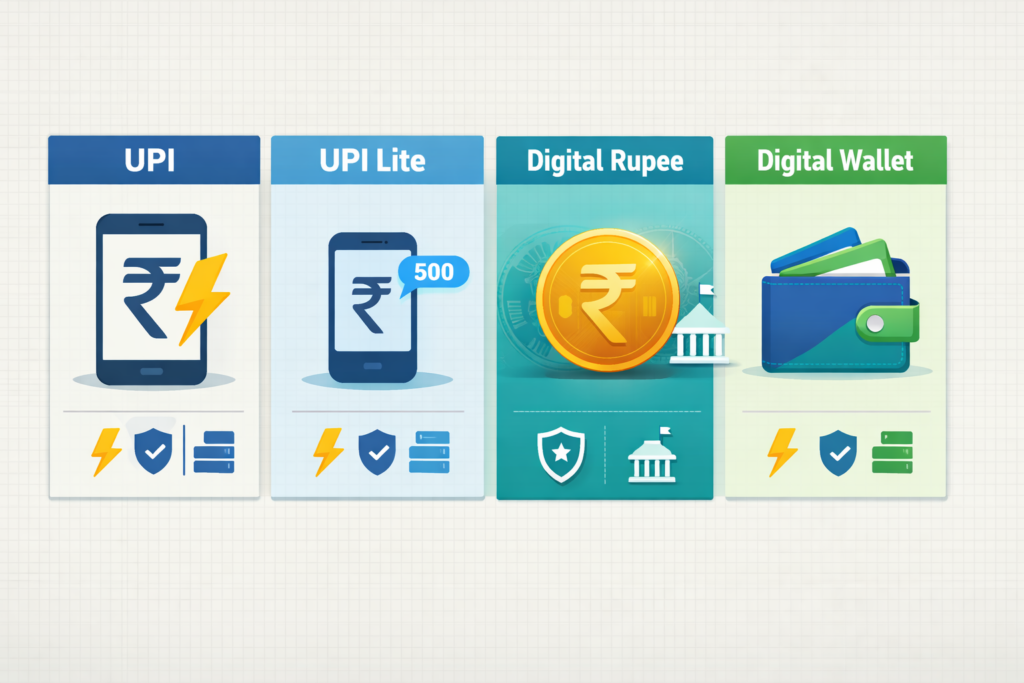
UPI Variants: Choosing the Right Tool for Your Income
By 2026, “UPI” isn’t a single product anymore. It’s a suite of options, each optimized for different scenarios.
| Payment Method | Best For Freelancers | Settlement Speed | Limit | Security |
|---|---|---|---|---|
| Standard UPI (P2P) | Receiving from individual clients or retainers | Instant (within seconds) | ₹1 lakh per transaction | RBI-regulated, two-factor auth |
| UPI Lite | Quick micro-payments, offline capability | Instant | ₹500 per transaction | Fast but lower transaction size |
| Digital Rupee (e-Rupee) | Future-proofing for CBDC adoption; digital-first transactions | Instant (CBDC rails) | ₹5 lakh (retail pilot) | Government-backed, RBI control |
| Digital Wallet (PhonePe/Google Pay) | Budget control; discretionary spending tracking | Instant | Varies (₹1-5 lakh) | Provider-dependent, not RBI-backed |
What most freelancers get wrong: They treat all payment methods as equivalent. Reality: UPI should be your primary income channel (it’s the most secure, fastest, and tax-compliant). Digital wallets should be secondary for discretionary spending, not income management.
Practical insight for 2026: The RBI is piloting the Digital Rupee (e-Rupee) with 82 lakh users across 11 lakh merchants. By mid-2026, expect CBDC-based transactions to become standard for inter-bank settlements. For freelancers, this means even faster settlement times—potentially within milliseconds rather than seconds.
The AI Budgeting Evolution: From Manual Tracking to Automatic Intelligence
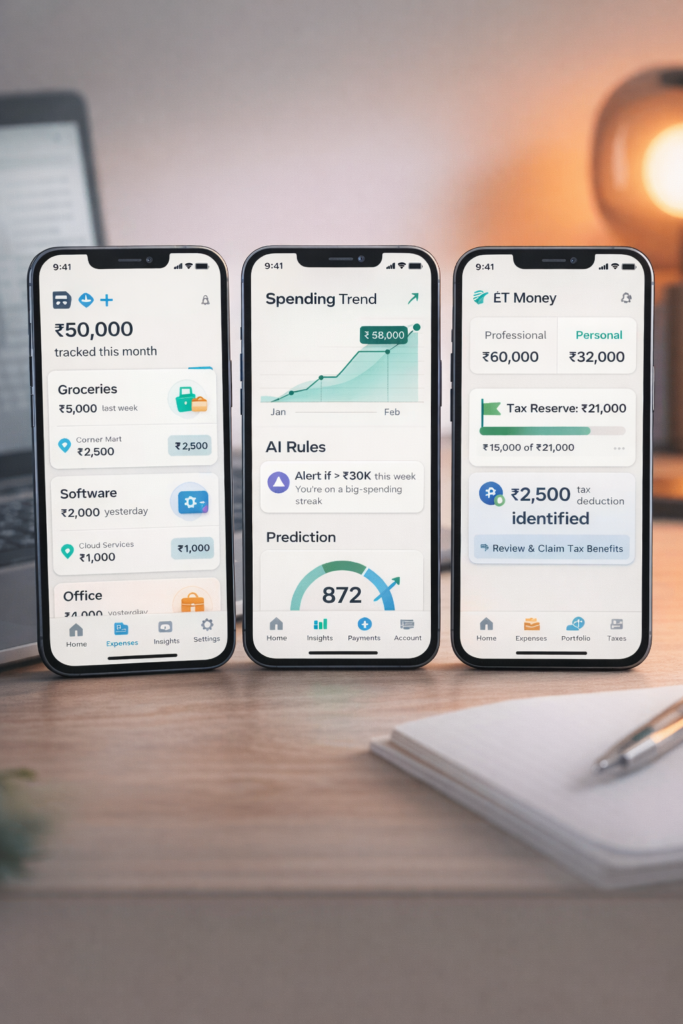
Five years ago, the best budgeting app for Indian freelancers was a spreadsheet. By 2026, AI-powered budgeting is the standard.
Apps like Walnut, Fi Money, Money View, and ET Money now offer:
- Automatic SMS-based transaction categorization – Every payment is categorized within seconds using machine learning, eliminating manual data entry
- Spending pattern recognition – The app learns your habits and alerts you when you’re trending above your usual spend
- Multi-wallet integration – Track UPI, savings account, credit card, digital wallet, and investment portfolio in a single dashboard
- Tax-aware expense tracking – Automatic tagging of deductible expenses (home office, software subscriptions, equipment) that sync directly with ITR filing software
Real-world impact: A freelancer who previously spent 3 hours per month manually tracking expenses in a spreadsheet now gets the same data in real-time, automatically categorized, with AI-generated spending recommendations.
| AI Budgeting App | Best Feature for Freelancers | Cost | Indian Tax Integration |
|---|---|---|---|
| Walnut | Automatic SMS transaction categorization; zero manual input | Free | Limited (basic tracking) |
| Fi Money | AI spending rules and automation; predictive financial health | Free + Premium ₹199/mo | ETMoney partnership integration |
| Money View | Investment + budgeting in one platform; wealth tracking | Free + Premium ₹99/mo | Tax-saving recommendations linked to investments |
| ET Money | Dedicated tax deduction tracking; ITR filing templates | Free + Premium ₹299/mo | Direct integration with income tax filing |
| Moneyfy | Separate professional vs. personal budget buckets; freelancer-specific | Free + Premium ₹149/mo | Professional expense tracking for ITR-4 filers |
What most freelancers get wrong: They assume all budgeting apps are the same. Reality: Apps designed for salaried employees (fixed income, monthly budget) fail for freelancers. You need an app that handles variable income, multiple income streams, and tax deduction tracking. ET Money and Moneyfy are specifically designed for this scenario.
The Foundation: Income Management for Irregular Earners
Before we talk about saving, investing, or scaling, we need to solve the fundamental problem: you don’t know how much you’ll earn next month.
This uncertainty ripples through every financial decision. How much can you spend? How much should you set aside for taxes? What emergency fund size is appropriate when your income ranges from ₹30,000 to ₹2,50,000 monthly?
Traditional financial advice breaks down here. It assumes stable, predictable income. You need a framework built for volatility.
The Income Segregation Strategy: Why Your Business Needs Its Own Account
Most freelancers make a critical mistake in month one: they let client payments flow into their personal savings account.
Why is this a problem? Three reasons:
1. Tax compliance becomes impossible
When your personal savings account is mixed with business income, you can’t distinguish between what you earned from freelancing and what you earned from other sources (gift from parents, interest on savings, etc.). The tax department needs to see your business income in isolation to assess tax liability correctly.
2. Expense deductions get tangled
You can deduct business expenses (software licenses, home office, equipment) only if they’re traceable separately from personal expenses. When you buy a ₹2,000 WordPress plugin using your personal debit card, is it a personal expense or business expense? If it’s mixed with groceries and personal shopping, the tax department won’t give you the deduction.
3. Bookkeeping becomes a nightmare
When it’s time to file your ITR (Income Tax Return) or GST forms, you need to extract 12 months of business transactions from a mixed account statement. What should take 1 hour takes 4 hours. What costs ₹500 in CA fees costs ₹1,500.
The solution: Open a separate bank account for your freelance business before you get your first client payment. This account:
- Receives all client payments
- Pays for all business expenses
- Is kept completely separate from personal money
Most banks in India now offer free business accounts for freelancers. ICICI, HDFC, Axis, and regional banks like Kotak all have “freelancer savings accounts” that cost ₹0 to open, with no monthly charges if you maintain a minimum balance of ₹1,000-5,000.
Setup time: 2 hours (online account opening + UPI activation)
Financial impact: Saves ₹5,000-15,000 per year in CA fees, plus protects you from tax disputes
The 50% Tax Buffer Strategy: Why You’re Probably Overpaying or Underpaying Taxes
Here’s a scenario that plays out for 70% of new freelancers in India:
Scenario A: The Overpayer
- June income: ₹3 lakhs
- Panic: “I need to set aside 30% for taxes!”
- Sets aside: ₹90,000
- Pays in July: ₹90,000 as advance tax
- August income: ₹50,000
- Realizes: With basic exemption limit and presumptive taxation, actual tax is only ₹15,000 total
- Result: Locked away ₹90,000 when actual tax owed is ₹15,000. Lost opportunity cost: ₹5,000+ in missed investments.
Scenario B: The Underpayer
- June income: ₹80,000
- July income: ₹1,50,000
- Thinks: “Average income is ₹1,15,000, I’ll set aside 20% = ₹23,000”
- Doesn’t account for: Progressive tax slab increases as income grows
- November: Tax department notice arrives
- Realizes: Actual tax liability was ₹60,000 across the year
- Pays penalty of: ₹10,000+ under Section 234B (interest on late payment)
Both scenarios are avoidable with one simple framework: The 50% Presumptive Taxation Buffer.
How Presumptive Taxation Works (Section 44ADA)
If you’re a freelancer earning less than ₹50 lakhs annually AND you receive at least 50% of your income via digital channels (UPI, bank transfer, credit card payments—basically anything that isn’t cash), you qualify for presumptive taxation under Section 44ADA.
Here’s what this means in plain English:
Instead of calculating actual profit = Revenue – All Expenses, you can declare:
Presumptive Profit = 50% of Gross Revenue
You don’t need to maintain detailed expense records. You don’t need to prove every software purchase, every home office cost, every internet bill. You simply take 50% of your total revenue and declare that as taxable income.
Practical example:
Freelancer Profile: Content writer, Delhi, FY 2025-26
| Metric | Amount |
|---|---|
| Total revenue from clients (Jan-Mar 2026) | ₹2,50,000 |
| Digital payment % (via UPI) | 100% |
| Qualifies for presumptive taxation? | YES |
| Presumptive profit (50% of revenue) | ₹1,25,000 |
| Basic exemption limit (new tax regime 2026) | ₹4,00,000 |
| Tax payable on ₹1,25,000 income | ₹0 (below exemption) |
| Rebate under Section 87A | N/A (income below slab) |
| Actual tax due: | ₹0 |
Contrast this with actual expense tracking:
If this freelancer tried to track actual expenses:
- Home office (20% of ₹15,000 rent) = ₹3,000
- Internet (50% of ₹1,000 bill) = ₹500
- Software subscriptions = ₹2,000
- Equipment depreciation = ₹5,000
- CA fees = ₹5,000
- Total deductions: ₹15,500
- Actual profit: ₹2,50,000 – ₹15,500 = ₹2,34,500
- Tax payable: ₹35,000+
Which is better? Presumptive taxation saves ₹35,000 in taxes and eliminates the need to track and justify ₹15,500 in expenses.
The catch: You must keep digital payment receipts. If 70% of your income comes via cash, you can’t use presumptive taxation. This is why freelancers in 2026 are increasingly asking clients to pay via UPI instead of cash—it unlocks presumptive taxation benefits.
The Quarterly Advance Tax Framework: Automating Your Tax Buffer
Once you know your presumptive tax liability, the next step is splitting it into quarterly payments to avoid penalties and interest.
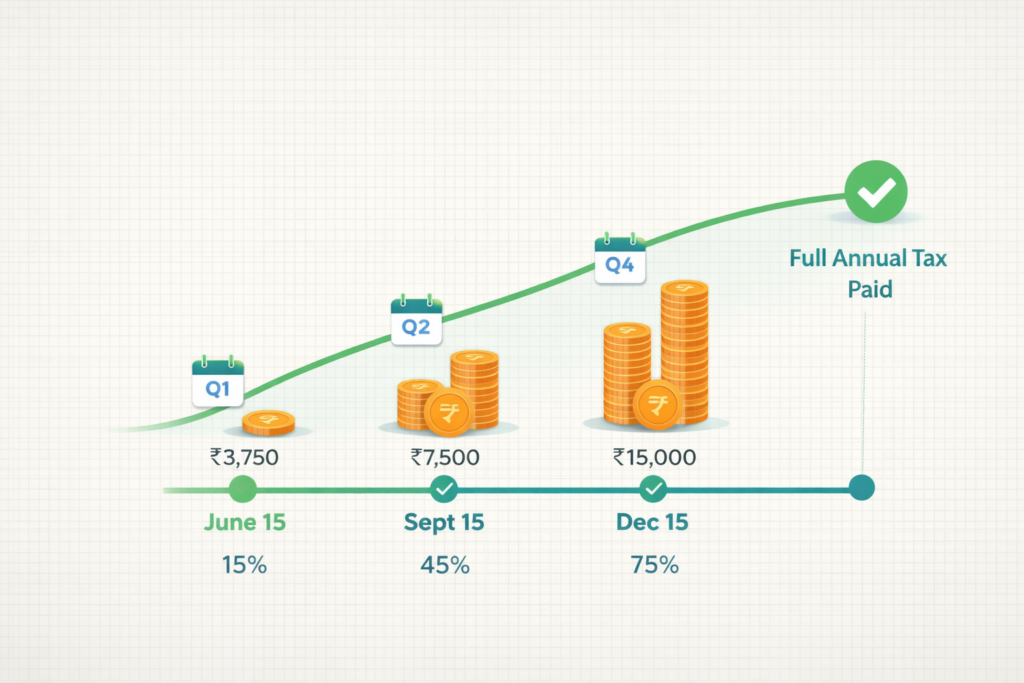
If your annual presumptive tax liability exceeds ₹10,000, you’re required to pay advance tax in four installments:
- Q1 (June 15): 15% of your total tax liability
- Q2 (September 15): 45% (cumulative)
- Q3 (December 15): 75% (cumulative)
- Q4 (March 15): 100% (final payment)
How to implement this in 2026:
- Estimate your annual revenue – Look at last 3-6 months and project forward
- Calculate 50% as presumptive profit – This is your taxable income
- Look up your tax slab – For FY 2026, if income is between ₹4 lakhs-₹6 lakhs, your marginal tax rate is 5%
- Calculate total tax = Presumptive profit × Tax rate
- Split into quarters – Automate it by setting a calendar reminder to transfer the quarterly amount to a separate “tax savings” account
Real example for ₹6 lakh annual revenue freelancer:
| Quarter | Cumulative Expected Revenue | Presumptive Tax Due | Your Advance Tax Payment |
|---|---|---|---|
| Q1 (April-June) | ₹1.5 lakhs | ₹3,750 (15% of annual ₹25,000) | ₹3,750 → Transfer to tax account |
| Q2 (July-Sept) | ₹3 lakhs | ₹11,250 (45% of ₹25,000) | ₹7,500 → Additional transfer |
| Q3 (Oct-Dec) | ₹4.5 lakhs | ₹18,750 (75% of ₹25,000) | ₹7,500 → Additional transfer |
| Q4 (Jan-Mar) | ₹6 lakhs | ₹25,000 (100% of annual) | ₹6,250 → Final transfer |
| Annual total | ₹6 lakhs | ₹25,000 | Paid in four chunks |
This framework protects you from:
- Interest penalty (₹5,000+ annually if you underpay)
- Late payment interest (up to 1% per month)
- Cash flow crunch (paying ₹25,000 in one lump sum in July vs. ₹3,750 every quarter is psychologically and financially easier)
Implementation: Set up a recurring calendar alert for June 15, Sept 15, Dec 15, March 15. On each date, transfer your quarterly tax amount to a separate savings account (yes, in the same bank). When filing ITR in July, you’ll have the full amount ready.
The Emergency Fund for Freelancers: More Than 3 Months
Standard financial advice says: “Keep 3-6 months of expenses as an emergency fund.”
For salaried employees, this works. Their income is stable, so they can confidently calculate: “If I lose my job, I can sustain myself for 6 months while finding a new one.”
For freelancers, this advice is dangerously inadequate.
Here’s why: Your income isn’t just “at risk” occasionally (like job loss). Your income is structurally variable. A 50% income drop in one month is normal, not a crisis. If a major client pauses their project or a payment gets delayed, your monthly income can drop from ₹1,50,000 to ₹30,000 overnight.
With only 3 months of expenses saved, a 2-month income drought depletes your emergency fund almost entirely. You’re left vulnerable to medical emergencies, equipment failures, or other unexpected costs.
The freelancer emergency fund formula:
6-12 months of expenses + 1 month of average tax buffer
For a freelancer with monthly expenses of ₹40,000 and ₹2,000 average monthly tax liability:
- Minimum emergency fund: (₹40,000 × 6) + ₹2,000 = ₹2,42,000
- Ideal emergency fund: (₹40,000 × 12) + ₹2,000 = ₹4,82,000
This sounds daunting, but consider the alternative: A medical emergency that costs ₹1 lakh while your emergency fund is depleted forces you to take a high-interest personal loan at 12-15% APR, costing you an extra ₹5,000-7,500 in interest charges.
How to build it incrementally:
Most freelancers can’t save ₹2,42,000 in one month. Instead:
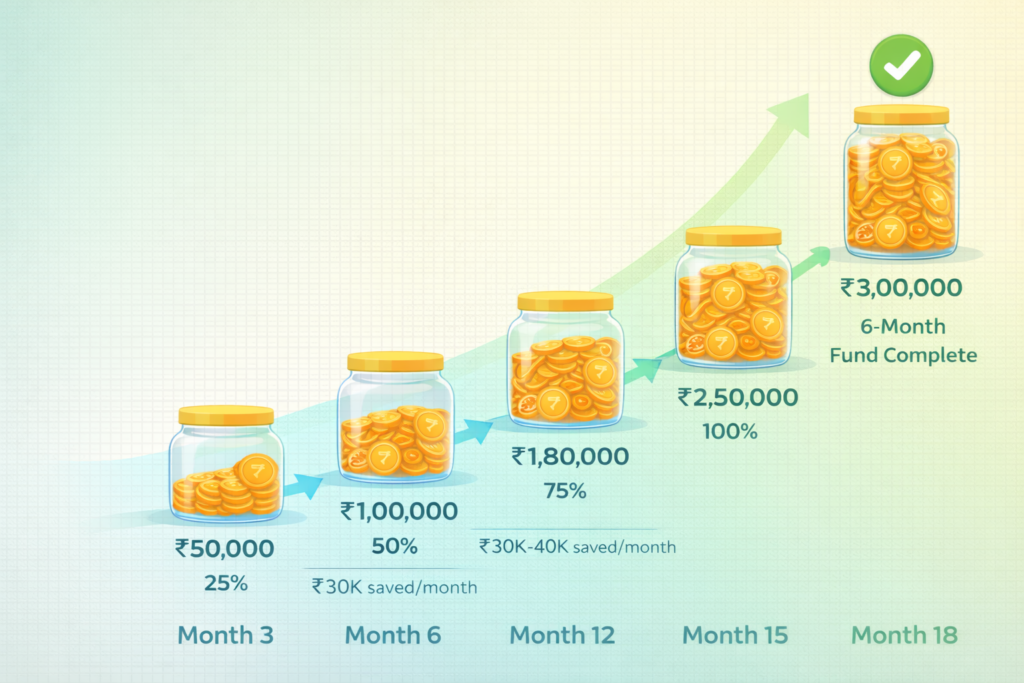
- Month 1-3: Save 50% of “extra” income (income above your monthly average) → Should reach ₹30,000-50,000
- Month 4-6: Save 40% of extra income → Add ₹25,000-40,000 more
- Month 7-12: Save 30% of extra income as you gain confidence → Reach ₹1.5-2 lakhs
- Year 2: Aim for the full 6-month target
Real-world timeline:
Freelancer earning ₹60,000 average monthly (₹50,000 stable, ₹10,000 variable):
- After 6 months: ₹1 lakh saved
- After 12 months: ₹1.8-2.2 lakhs saved
- After 18 months: ₹2.5-3 lakhs (6-month fund) ✓
Where to keep it:
- High-yield savings account (5-5.75% interest): IDFC FIRST, Axis Bank, ICICI (if balance ≥ ₹5 lakhs)
- Liquid mutual funds (5-6.5% returns, slightly less liquid but marginally higher returns): Liquid/Overnight funds from HDFC, ICICI, Axis MF
- Do NOT keep in: Current account (0% interest), Fixed Deposit with lock-in (illiquid), Crypto (too volatile)
The math: Keep ₹2,42,000 in a high-yield savings account earning 5.5%, and you’re generating ₹13,310 in annual interest—basically a free month of expenses annually.
Common Tax & Money Mistakes That Cost Freelancers Thousands
Let’s talk about what actually goes wrong. Not in theory, but in practice—the mistakes that lead to tax notices, penalties, and regret.
Mistake #1: Not Filing ITR Even Below the Exemption Limit
The thinking: “I earned ₹3 lakhs this year. The basic exemption limit is ₹4 lakhs. I don’t need to file ITR.”
Why this is wrong: The basic exemption limit determines tax liability, not filing obligation. Two different things.
According to the Income Tax Act, you must file ITR if:
- You have any income above ₹10,000 (yes, ₹10,000—not ₹4 lakhs)
- You’re engaged in any business or profession
- You made any foreign tour or spent over ₹2 lakhs on travel
- You had foreign income
- You claimed any deduction under Chapter VIA (like Section 80C, 80D)
Most freelancers fall into category #2 alone: “engaged in business/profession.”
What happens if you don’t file:
- Tax department can initiate probe under Section 245(1) after 2 years
- If discovered, you face:
- Interest penalty: 1% per month on unpaid tax (up to 36 months = 36% cumulative)
- Late payment surcharge: 25% of tax due
- Prosecution possibility if deemed intentional evasion
Real example:
₹3 lakh freelance income, no ITR filed for FY 2022-23. In January 2026, tax notice arrives.
- Tax due: ₹0 (below exemption)
- But… penalty for not filing: ₹500 (under Section 271F) + investigation costs
- Interest (missed 3 years): ₹0 (since tax is ₹0)
- Time wasted: 10+ hours responding to notice
What to do in 2026:
File ITR every year, no exceptions. Use ITR-4 (for presumptive taxation) or ITR-3 (detailed). Cost: ₹0-2,000 if DIY via ClearTax/Taxify, ₹3,000-5,000 if using CA.
Mistake #2: Mixing Personal & Business Expenses (And Losing Deductions)
This is the most expensive mistake.
The scenario:
You buy a ₹5,000 software subscription on your personal credit card (50% for work, 50% for side project). You note it down and claim the full ₹5,000 as a business deduction on your ITR.
Tax auditor during review: “Show me the invoice mentioning your business name.”
You: “It’s on my personal credit card…”
Auditor: “Sorry, personal payment. No deduction.”
You lose a ₹5,000 deduction. Depending on your tax slab, this costs you ₹750-1,500 in additional taxes (plus penalties if audited).
Why it matters:
When you claim a business expense on your ITR, the tax department expects to see an invoice or receipt that clearly identifies it as business-related. A personal credit card statement shows:
- “Amazon payment ₹5,000”
- “PhonePe transfer ₹5,000”
It doesn’t show what the payment was for. A business invoice shows:
- “Software subscription for freelance editing platform – ₹5,000”
One is defensible in an audit, the other is not.
The fix for 2026:
- Separate business account receives all income, pays all business expenses
- Maintain digital records: Screenshot invoices, save email confirmations, keep receipts for 6+ years
- Expense categorization: Use budgeting app to tag expenses as deductible (home office, equipment, software) vs. personal
- Annual reconciliation: Before filing ITR, print your business account statement and verify every expense was genuinely business-related
What you CAN actually deduct as a freelancer:
- Home office (proportional rent/mortgage interest: If office = 20% of home area, claim 20% of rent)
- Internet & mobile (proportional: If 70% business use, claim 70% of bill)
- Software subscriptions (fully, if business-related: Canva, Adobe, Figma, etc.)
- Equipment & depreciation (laptop, camera, microphone: Claim depreciation over 5 years)
- Professional fees (CA, legal advice)
- Travel (for client meetings, conferences)
- Health insurance (Section 80D deduction)
What you CANNOT deduct:
- Personal groceries or dining
- Car fuel (unless you can prove it’s purely for client visits)
- Entertainment/movies
- Gym membership (unless you’re a fitness coach)
- Personal clothing
Mistake #3: Missing GST Registration Deadline
The scenario:
You’ve been freelancing for 8 months. This month, you cross ₹20 lakhs in annual turnover. You think: “I’ll register for GST next month when it’s convenient.”
You continue to bill without GST for 2 more months. By the time you realize, you’re overdue.
What happens:
- GST registration becomes mandatory the day you cross ₹20 lakhs
- Filing returns without registration = violation
- Penalty: ₹10,000 or 10% of GST liability, whichever is higher
- Back tax: You owe GST on all invoices from day you crossed the threshold
- Reputation damage: If you’ve already invoiced clients without GST, correcting it later is awkward
GST rules for freelancers (2026):
- Turnover threshold: ₹20 lakhs (₹10 lakhs for special category states: NE states, Himachal, Uttarakhand, J&K)
- Registration timeline: Within 30 days of crossing threshold
- GST rate for services: 18% standard, but varies (consultancy = 18%, content creation = 18%, design = 18%)
- Quarterly filing: GSTR-1 (sales), GSTR-2A (purchases), GSTR-3B (summary)
The registration process (2026):
- Go to GST portal (www.gst.gov.in)
- Click “New registration”
- Fill Form GST-REG-01 (digital, auto-calculates fields)
- Submit with PAN, Aadhaar, address proof, bank details
- Wait 1-2 days for provisional registration
- Upload compliance documents (ITR, balance sheet if applicable)
- Receive final registration in 3-5 days
Time required: 30 minutes online + 1-2 days processing
Real-world example:
Freelancer earning ₹1,80,000 in June, ₹3,00,000 in July. Crosses ₹20L threshold in July.
- Deadline to register: August 10
- If not registered by August 10: Liable for penalty
- Back GST owed on ₹3L invoice: ₹54,000 (18% GST)
- Penalty if discovered: ₹5,400-10,000
Avoid it: Estimate your annual revenue 2 months in advance. If trending toward ₹20L, register preemptively (no harm in early registration).
Mistake #4: Using No-Cost EMI for Non-Emergency Purchases
This one kills financial discipline faster than anything else.
The scenario:
You see a ₹50,000 laptop on a brand’s website. It offers “No-Cost EMI – 12 months, 0% interest.”
Your thinking: “It’s 0% interest, so I’m not losing money. I might as well buy now and spread the payments.”
You take the EMI. What the website doesn’t tell you:
- Implicit GST costs: The seller embeds GST (18%) into the effective price, even though it’s not visibly stated
- Opportunity cost: That ₹50,000 could have earned 5-6% annually in a savings account or liquid fund
- Cash flow risk: You now have ₹4,167 committed monthly for 12 months. If a client delays payment and your income dips, this EMI is due regardless
- Credit score impact: EMI counts against your debt-to-income ratio, lowering your credit limit and increasing future borrowing costs
Real math on “No-Cost EMI”:
| Metric | Value |
|---|---|
| Laptop price (MRP) | ₹50,000 |
| Effective price with embedded GST | ₹59,000 (18% GST) |
| EMI for 12 months @ 0% declared | ₹4,917/month |
| Total paid | ₹59,000 (EMI × 12) |
| Opportunity cost (if you had saved ₹50K and invested at 5.5% annual) | ₹1,375 |
| Actual cost = ₹59,000 + ₹1,375 = ₹60,375 | |
| Effective interest rate | ~3.8% |
So “0% interest” actually costs you ₹3,800-4,000 in hidden costs.
For freelancers specifically: No-cost EMI is even more dangerous because you have irregular income. In month 6, when your income is lower than expected, that ₹4,917 EMI doesn’t care—it’s due anyway.
What to do instead:
- For urgent equipment (laptop failure, camera upgrade): Use no-cost EMI only if income is stable (subscription clients) and you have 6-month emergency fund
- For non-urgent purchases: Save and buy cash. This forces you to spend less and gives you time to decide if you actually need it
- For optional purchases: Avoid EMI entirely
Mistake #5: Investing in ULIPs Instead of Direct Mutual Funds
The scenario:
An insurance agent visits and pitches a “Unit-Linked Insurance Plan (ULIP)” – a hybrid insurance + investment product. He shows projections: ₹1 lakh invested annually becomes ₹20 lakhs in 15 years.
You invest. After 5 years, actual value: ₹3.2 lakhs (vs. projected ₹5 lakhs). You realize the fees were eating returns.
Why ULIPs fail for freelancers:
| Aspect | ULIP | Direct Mutual Fund |
|---|---|---|
| Expense ratio (annual fee) | 1.5-2.5% | 0.3-0.8% |
| Hidden charges | Policy admin fee ₹1,000-2,000/yr, surrender charges up to 8% | None (if direct plan, not regular) |
| Flexibility | Lock-in 5 years, surrender penalty if withdrawn early | Liquid, withdraw anytime (LTCG tax applies) |
| Insurance coverage | Life cover 100-150% of investment | None (but you can buy separate term insurance) |
| Tax efficiency | LTCG taxed at 10% (if held 1yr+) | LTCG taxed at 10% (if held 1yr+) |
| Expected return | 8-10% average (net of fees) | 11-13% average (net of fees) |
| Suitability for irregular income | Poor (fixed annual premium required) | Excellent (invest lump sums when cash available) |
Real comparison (₹1,00,000 invested over 5 years in 10% growth environment):
ULIP scenario:
- Total invested: ₹5,00,000
- ULIP fees (average 2% per year on AUM): ₹55,000 cumulative
- Final value: ₹7,25,000
- Net return: 45% (₹2,25,000 gain)
Direct MF scenario:
- Total invested: ₹5,00,000
- MF fees (average 0.5% per year on AUM): ₹13,000 cumulative
- Final value: ₹8,37,000
- Net return: 67% (₹3,37,000 gain)
Difference: ₹1,12,000 more in wealth with direct MF after 5 years (due to lower fees).
What to do in 2026:
- Insurance: Buy term insurance separately (₹25 lakhs cover = ₹200-400/month for young freelancers)
- Investment: Use direct mutual funds via platforms like ET Money, MirrorAssets, or direct app of HDFC/ICICI/Axis MF
- Savings: For emergency fund, use high-yield savings or liquid funds (not insurance products)
Mistake #6: Not Tracking Subscription Costs & Recurring Charges
The scenario:
You subscribe to Adobe Creative Cloud (₹650/month). You also get:
- Canva Pro (₹95/month, international)
- Buffer social scheduling (₹99/month)
- Substack Pro (₹60/month)
- Figma (₹120/month)
- Grammarly (₹120/month)
- ChatGPT Plus (₹200/month)
- Zapier automation (₹50/month)
Total: ₹1,394 per month = ₹16,728 per year.
Six months in, you realize: “I’m only using 3 of these.”
You never cancel them. Over a year, you’ve wasted ₹5,500-8,000 on unused subscriptions.
For a freelancer earning ₹60,000/month, this 8% waste of income is significant.
Why it happens:
- Each subscription is a small ₹50-200 charge, so it feels harmless
- Free trials auto-convert to paid without reminder
- You forget what you subscribed to
- No central dashboard showing all recurring charges
How to fix in 2026:
- Audit all subscriptions (January):
- Check last 12 months of credit card/bank statements
- Search for “subscription,” “recurring,” “auto-renew”
- List every recurring charge
- Mark as: “Using regularly” / “Using rarely” / “Not using”
- Cancel everything you’re not using actively
- Expected savings: ₹2,000-6,000/month for most freelancers
- Use a subscription tracker (2026 options):
- Tracxn (tracks all subscriptions in one place)
- Zuora (for business subscriptions)
- Or simple Google Sheet with renewal dates
- Set calendar reminders
- Quarterly (Jan 1, Apr 1, Jul 1, Oct 1): Review active subscriptions
- Before renewal: Decide if you’ll keep it
Expected financial impact: Freelancer wasting ₹10,000/year on unused subscriptions reclaims ₹10,000 annually—basically one free month of buffer money.
Choosing the Right Tools: AI Budgeting Apps for Irregular Income
At this point, you understand the why (irregular income needs special systems) and the what (tax buffers, emergency funds, GST compliance). Now comes the how: which tools actually work for freelancers in 2026.
The Budgeting App Ecosystem for Freelancers
By 2026, “budgeting app” has evolved. It’s no longer just about tracking expenses. The best apps for freelancers now:
- Automatically categorize transactions using AI
- Separate professional from personal spending
- Identify tax deductions
- Alert you when spending deviates from patterns
- Integrate with tax filing platforms
Here’s the honest comparison:
| App | Best For | Key Features | Cost | Setup Time | Tax Integration |
|---|---|---|---|---|---|
| Walnut | Hands-off, automatic tracking | SMS-based auto-categorization, zero manual entry, real-time alerts | Free | 15 min (SMS permission) | No direct ITR, but exports data |
| Fi Money | AI spending insights | Automation rules (“If spending >₹30K this month, alert me”), predictive financial health, wealth dashboard | Free + Premium ₹199/mo | 20 min | Partial (via partner integration) |
| Money View | Holistic wealth tracking | Investment portfolio + expense tracking, tax-saving recommendations, insurance overview | Free + Premium ₹99/mo | 25 min | Linked to tax software |
| ET Money | Tax-aware freelancers | Dedicated ITR filing templates, deduction tracker, tax-saving recommendations, professional expense tags | Free + Premium ₹299/mo | 30 min | Direct ITR filing in-app |
| Moneyfy | Professional budget separation | Separate “professional” vs “personal” buckets, freelancer-specific templates, GST-aware tracking | Free + Premium ₹149/mo | 20 min | Professional expense reports for CA |
My recommendation for most freelancers: Start with Walnut (free, zero setup friction, automatic tracking). In 6 months, if you want tax integration, migrate to ET Money (premium ₹299/mo but saves ₹2,000-3,000 in CA fees annually).
Implementation: Setting Up Your Budgeting System in 24 Hours
Hour 1: Account Connection (30 minutes)
- Download Walnut app (or your chosen platform)
- Log in with your PAN / mobile number
- Connect your business bank account (UPI login or net banking)
- Connect your personal bank account (if you want unified tracking)
- Grant SMS permission (required for auto-categorization)
Hour 2: Expense Category Setup (20 minutes)
Create 8-10 expense categories relevant to your freelance business:
- Business Essentials: Software, tools, subscriptions
- Office: Home office rent (proportional), internet, electricity
- Equipment: Laptop, camera, microphone (depreciation)
- Professional Development: Courses, certifications, conferences
- Client Payments: Subcontractors, outsourced work
- Taxes & Compliance: CA fees, accounting software, GST filings
- Travel: Client meetings, conferences, research
- Uncategorized: (The app will auto-fill this; you categorize weekly)
Hour 3: Income Stream Setup (15 minutes)
- Tag income sources:
- Client A: ₹X/project (irregular)
- Subscription retainer: ₹X/month (regular)
- Affiliate income: ₹X/month (variable)
- Other: Specify
- Set up income goals:
- Minimum monthly target: ₹50,000
- Ideal monthly target: ₹80,000
- Stretch target: ₹1,20,000
The app will now alert you if your monthly income is trending below target.
Hour 4: Tax Buffer Automation (20 minutes)
- Calculate your quarterly tax payment (from earlier framework):
- Annual expected revenue: ₹X
- Presumptive profit (50%): ₹X/2
- Tax slab: [X%]
- Quarterly payment: (Annual tax) / 4
- In the app, create a “Tax Reserve” goal:
- Allocate the quarterly amount monthly (or manually on due dates)
- Set reminders for June 15, Sept 15, Dec 15, March 15
- Outside the app: Open a separate high-yield savings account (or liquid fund) where you’ll park this tax money
The system is now automated. Every month, the app tells you exactly how much to move to your tax savings account.
Hour 5: First Month Review (15 minutes)
Wait 1 week. By then, the app has collected data from one week of transactions.
- Check categorization accuracy (usually 80-85% auto-correct)
- Manually fix miscategorizations (e.g., “Starbucks” marked as business when it’s personal)
- Review spending patterns
After 1 month of data, the app’s AI will start predicting your average spending and alerting you to anomalies.
Timeline expectations:
- Week 1: App is learning categories
- Week 2-4: ~85% of transactions auto-categorized correctly
- Month 2-3: You have reliable spending patterns, AI makes recommendations
- Month 4+: Automated alerts if you’re trending above/below your targets
Payment Methods: UPI vs. Wallets vs. Digital Rupee
By now, you understand the why (separation of income and expense) and the how (which tools to use). But one more critical decision: how do you actually receive client payments?
For Indian freelancers in 2026, you have four realistic options, each with trade-offs.
Option 1: UPI (Unified Payments Interface)
How it works:
Client sends you ₹50,000 via UPI. Within 2-3 seconds, it lands in your bank account. No middleman, no processing delay.
Pros for freelancers:
- ✓ Instant settlement (2-3 seconds)
- ✓ Free (no charge to receive)
- ✓ RBI-regulated, bank-level security
- ✓ Automatic tax trail (every transaction logged with NPCI, linked to PAN)
- ✓ Scaled for high volume (19.47B transactions monthly, zero downtime issues)
- ✓ International support growing (UPI available to NRIs, foreign payments incoming 2026-27)
Cons:
- Transaction limit: ₹1 lakh per transaction (for most banks)
- If receiving ₹2 lakh, client sends two ₹1L transfers
- Requires both parties to have UPI (increasingly universal, but not 100%)
When to use: For 95% of your freelance income. Default payment method.
Tax implication: Every UPI payment creates an automatic record. For presumptive taxation, you need 50% of income via digital channels. UPI 100% qualifies.
Option 2: Digital Wallets (PhonePe, Google Pay, Paytm)
How it works:
Client sends payment to your wallet. Money appears in wallet balance, then you transfer to bank (overnight settlement, sometimes with fee).
Pros:
- ✓ High UX (sending via wallet is intuitive, even for non-tech clients)
- ✓ Rewards/cashback (some wallets offer 1-2% cashback)
- ✓ Mobile-first (works on even basic smartphones)
Cons:
- ✗ Slower settlement (overnight to 2 days, vs. UPI’s 2 seconds)
- ✗ Transfer to bank may have fee (₹20-50 per transfer)
- ✗ Wallet provider bankruptcy risk (theoretically, your balance could be at risk if provider fails—though Indian wallets are mostly protected)
- ✗ Tax disadvantage (wallet transfers don’t have same NPCI audit trail as UPI)
When to use: Only if client specifically prefers wallet. Not recommended as primary method.
Tax implication: Wallet transfers to bank are digital, so they count toward 50% digital payment requirement for presumptive taxation. But slower settlement makes it less suitable for cash flow management.
Option 3: Digital Rupee (e-Rupee / CBDC)
What it is:
Digital Rupee is the RBI’s Central Bank Digital Currency (CBDC). It’s rupees, but in digital form, backed 1:1 by the RBI. As of January 2026, the retail pilot includes 82 lakh users and 11 lakh merchants.
How it works:
- Client sends you ₹50,000 via Digital Rupee app
- Settlement happens on RBI’s servers (not bank servers), taking 100-500ms
- You have Digital Rupees in your wallet
- You convert to bank rupees (instant, 1:1 exchange, zero fee)
Pros:
- ✓ Fastest settlement (100-500ms, vs. UPI’s 2-3 seconds, vs. wallet’s overnight)
- ✓ Government-backed (zero counterparty risk)
- ✓ Perfect tax compliance (RBI maintains complete ledger of all e-Rupee transactions)
- ✓ Future-proof (this will be the backbone of Indian finance by 2030)
Cons:
- ✗ Low adoption (still in pilot phase, only 82L users as of Jan 2026)
- ✗ Not all clients can send via e-Rupee yet
- ✗ Wallets require specific setup (can’t use existing UPI apps)
Timeline: By mid-2026, expect 500L+ users. By 2027, mainstream adoption. By 2030, default standard.
When to use: If your clients have Digital Rupee enabled (likely for corporate clients, government agencies). For now (early 2026), not essential. But understand it for future-proofing.
Option 4: Bank Transfers (NEFT/RTGS)
How it works:
Client initiates bank-to-bank transfer via net banking. Takes 2-3 hours (NEFT), or 30 minutes (RTGS), or sometimes overnight.
Pros:
- ✓ Works with older clients (still using only net banking)
- ✓ Large transactions (no ₹1L limit like UPI)
Cons:
- ✗ Slow (2-3 hours or overnight)
- ✗ Fee (usually ₹5-25 per transfer)
- ✗ Outdated (UPI has made this obsolete for most use cases)
When to use: Rarely. Only for clients who specifically can’t do UPI. Or for high-value transactions >₹1 lakh (and even then, UPI allows multiple ₹1L transfers).
Tax Optimization: ITR Filing for Freelancers
Now we get to the part that makes freelancers nervous: filing taxes.
The good news: By 2026, ITR filing for freelancers has been simplified significantly. The bad news: Most freelancers still get it wrong because they use outdated strategies.
Which ITR Form Applies to You?
ITR-3 (Detailed Income from Business/Profession):
- Use if: You have gross receipts ≥ ₹50 lakhs OR you want to claim detailed business expenses
- Requires: Detailed Profit & Loss account, balance sheet, expense documentation
- Best for: Established freelancers, those with >₹50L revenue, complex deductions
- Complexity: Medium to high
ITR-4 (Presumptive Income Scheme):
- Use if: Gross receipts < ₹75 lakhs AND ≥50% digital payments AND you qualify for presumptive taxation
- Requires: No expense documentation (declare 50% of revenue as profit automatically)
- Best for: 95% of Indian freelancers
- Complexity: Low
Which should you choose?
99% of freelancers should use ITR-4. Here’s why:
| Metric | ITR-4 | ITR-3 |
|---|---|---|
| Filing time | 30 minutes | 3-4 hours |
| Documents needed | None (presumptive) | P&L, Balance sheet, invoices, receipts |
| Tax liability for ₹50L revenue | ₹2,50,000 (50% × 30% slab) | ₹2,50,000-3,50,000 (depending on actual expenses) |
| Audit risk | Low (presumptive is standard) | Higher (expense claims scrutinized) |
| CA cost | ₹1,500-2,500 | ₹5,000-10,000 |
Unless you have significant business expenses (>₹10 lakhs) that you can fully document, ITR-4 gives you the same tax liability with 80% less hassle.
The ITR-4 Filing Process (2026)
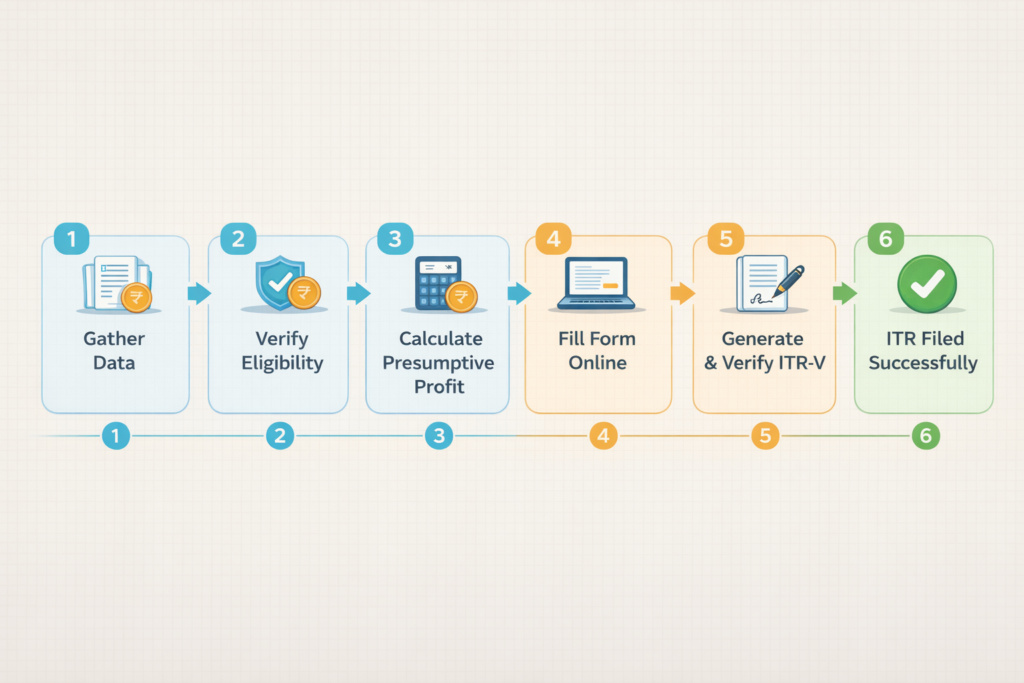
Step 1: Gather Data (30 minutes)
Before you even open the ITR form, collect:
- Your PAN, Aadhaar, date of birth, bank account details
- Total business income for the year (from UPI history, bank statements)
- Digital payment percentage (UPI transactions / Total revenue)
- GST registration number (if registered)
- TDS deducted on your income (from Form 26AS, available on income-tax.gov.in)
Step 2: Verify You Qualify for ITR-4 (5 minutes)
Check:
- ✓ Gross receipts < ₹75 lakhs? [Yes/No]
- ✓ Digital payments ≥ 50%? [Yes/No]
- ✓ Engaged in profession/business? [Yes/No]
If all three are YES, you’re eligible. Proceed.
Step 3: Calculate Presumptive Profit (5 minutes)
Formula:
Gross receipts (total revenue) × 50% = Presumptive profitExample:
Total revenue FY 2025-26: ₹50,00,000
Presumptive profit: ₹25,00,000
That’s it. No need to list ₹2,000 home office expense, ₹5,000 software cost, etc. The 50% presumption covers all of it.
Step 4: Fill ITR-4 Online (20 minutes)
Go to incometaxindiaefiling.gov.in
- Log in with PAN + password
- New return → Select ITR-4
- Financial year: 2025-26 (for Jan-Mar 2026 filing)
- Fill basic info:
- Name, PAN, Aadhaar, DOB
- Address
- Occupation: “Professional” or “Self-employed (Business)”
- Income section:
- Source: Business/Profession
- Gross receipts: ₹50,00,000
- Presumptive profit (50%): ₹25,00,000
- Standard deduction: ₹12,500 (automatic for ITR-4)
- Total income: ₹25,00,000 – ₹12,500 = ₹24,87,500
- TDS section:
- Add TDS deducted (from Form 26AS): e.g., ₹50,000
- Tax computation:
- System auto-calculates based on slab: e.g., ₹3,30,000
- Less: TDS already paid: -₹50,000
- Tax to pay: ₹2,80,000
- Bank details + Aadhaar OTP verification
- Submit
Step 5: Generate ITR-V (Verification)
After submission, you’ll see ITR-V on screen. Two options to complete the filing:
Option A: Digital Signature (instant)
If you have a digital signature certificate, you can sign ITR-V digitally. Filing is complete immediately.
Option B: Physical Verification (3 days)
- Print ITR-V
- Sign it manually
- Send to:
Chief CIT (address based on your jurisdiction)
Filing is complete 3 days after receipt
Most freelancers use Option B. Time required: 10 minutes printing + 5 days postal time.
Scaling Income: From Project Work to Subscription Revenue
Managing irregular income is important. But a higher goal is this: What if your income becomes less irregular?
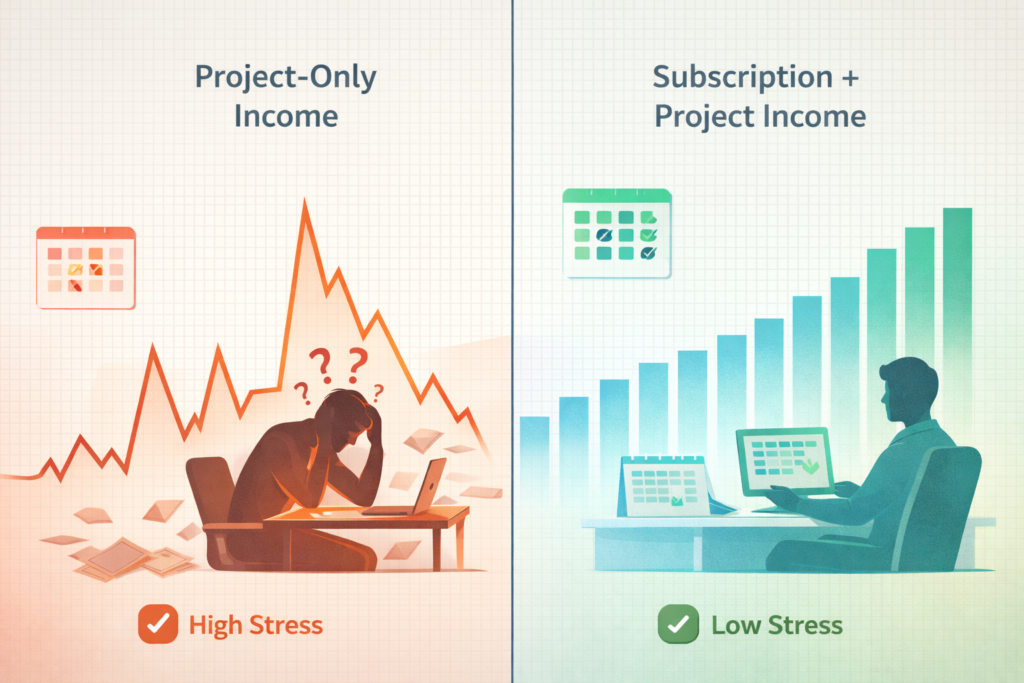
By 2026, the most successful freelancers have shifted from pure project work to subscription-based retainers. Instead of earning ₹50,000 on a project here, ₹80,000 on a gig there, they earn ₹60,000 monthly from retainer clients, with project income as a bonus.
Why this matters financially:
| Model | Monthly Income | Predictability | Tax Planning | Stress Level |
|---|---|---|---|---|
| Project-only | ₹30K-150K (highly variable) | Unpredictable | Difficult | High |
| 50% subscription + 50% projects | ₹60K-140K (anchored by retainer) | Predictable for 50% | Easy for half, variable for half | Medium |
| 70% subscription + 30% projects | ₹70K-110K (mostly stable) | Very predictable | Almost as easy as salaried | Low |
The financial advantage is clear. But how do you convert project clients to retainers?
The Subscription Model Conversion Strategy
Model 1: Monthly Deliverables
Example: Graphic designer offers “Monthly Design Package”
- 4 design deliverables per month
- Unlimited revisions on each
- 48-hour turnaround
- ₹30,000/month
Client benefits: Predictable design support, lower cost than project-by-project
Your benefits: Predictable ₹30,000 every month (₹360K annually)
Model 2: Hours Bucket
Example: Content strategist offers “Monthly Strategy Hours”
- 20 hours per month allocated
- Can be used for blog writing, strategy, analytics review—whatever the client needs
- ₹40,000/month
Client benefits: Flexibility, no worry about “using up” their budget
Your benefits: Guaranteed ₹40,000, can batch similar work
Model 3: Retainer + Project (Hybrid)
Example: Web developer offers “Maintenance Retainer”
- Website hosting/monitoring (₹15,000/month)
- Monthly updates and bug fixes (₹10,000/month)
- Additional project work at discounted rate (₹2,000/hour instead of ₹3,000/hour)
- ₹25,000/month baseline
Client benefits: Reliable support, discounted project rates
Your benefits: ₹25,000 baseline + project income bonus
Converting a Client to Subscription
Step 1: Identify Your Best Clients (Week 1)
Look at last 12 months of income. Find:
- Clients who pay you repeatedly (not one-off projects)
- Clients with high lifetime value (₹2 lakh+)
- Clients with predictable ongoing needs
Example: You’ve worked with Client A for 8 months, earned ₹3 lakh total. They keep asking “Can you do one more thing?” This is a subscription candidate.
Step 2: Map Their Ongoing Needs (Week 1)
Ask yourself: What does this client need every month that they currently pay per-project?
Example:
- 3-4 social media posts written and scheduled
- 1 email campaign
- Monthly analytics review
- Ad copy optimization
Total: Could be bundled as ₹20,000-25,000/month retainer instead of ₹4,000-7,000 per project.
Step 3: Create a Proposal (Week 2)
Write a short email proposing the retainer.
Step 4: Negotiate the Details (Week 3)
Most clients won’t accept the first proposal as-is. Expect negotiation.
Step 5: Set Boundaries & Terms (Week 4)
Write a simple 1-page statement of work (SOW).
Step 6: Implement & Track (Ongoing)
- Set up recurring invoice for 1st of every month
- Track monthly: Total hours spent vs. 20-hour bucket (if using hours model)
- Schedule quarterly check-in to assess value
Expected Conversion Rate & Timeline
- Clients who will say YES immediately: 20% (they’ve been wanting stability)
- Clients who’ll negotiate: 60% (they need terms adjusted)
- Clients who’ll say NO: 20% (prefer flexibility of project work)
Timeline: Over 6-12 months, if you have 10 active clients, convert 3-4 to subscriptions = ₹70,000-1,20,000 new baseline monthly income.
Financial impact:
- Before: Stressed about landing enough projects; income ranges ₹30,000-₹1,50,000/month
- After: 50% income is locked in; easier cash flow, tax planning, less stress
- Bonus: You work less (subscriptions are more efficient than constant project hunting)
Case Studies: Real Freelancers, Real Numbers, Real Results
Theory is fine. But what actually works in practice? Here are three case studies of Indian freelancers navigating 2026 finances.
Case Study #1: Arjun (Content Writer, Delhi NCR)
Background:
- Age: 28
- Experience: 5 years freelancing
- Income: ₹50,000-80,000/month (highly variable)
- Problems: Irregular income, no tax planning, overspending, zero savings
- Goal: Build emergency fund and save taxes
Situation (January 2026):
- 4 active clients (2 sporadic, 2 somewhat regular)
- No dedicated business account (income went into personal account)
- Spending: ₹35,000/month (groceries, rent, entertainment, subscriptions)
- Savings: ₹2,000/month (barely any)
- Emergency fund: ₹8,000 (3 days of expenses—dangerously low)
Results (6 months later, July 2026):
| Metric | Before (Jan) | After (Jul) | Change |
|---|---|---|---|
| Monthly average income | ₹65,000 | ₹72,000 | +10% (via more stable clients) |
| Monthly spending | ₹35,000 | ₹27,000 | -23% (subscription audit + lifestyle) |
| Emergency fund | ₹8,000 | ₹42,000 | +425% |
| Tax buffer allocated | ₹0 | ₹21,000 | Fully automated |
| Annual tax liability (planned) | Unknown | ₹84,000 | Clear visibility |
| CA consultation cost (saved) | ₹5,000/yr | ₹1,500/yr | -70% |
Key lessons:
- Subscription audit was highest-impact action (freed ₹5,000/month)
- Psychological shift: Tax buffer automated = one less worry each month
- Emergency fund building accelerated once spending was cut
Case Study #2: Priya (Web Designer, Bangalore)
Background:
- Age: 32
- Experience: 7 years freelancing
- Income: ₹1,20,000-1,80,000/month
- Problems: GST confusion, tax complexity, considering structured employment because “freelance finances are a nightmare”
- Goal: Optimize taxes, understand GST, streamline compliance
Results (6 months later, July 2026):
| Metric | Before (Jan) | After (Jul) | Change |
|---|---|---|---|
| Monthly baseline income | Variable, unknown | ₹65,000 | +Certainty |
| Annual turnover (projected) | ₹19.2L | ₹21L | +9% |
| Monthly variable income | ₹1.2-1.8L | ₹1.65-1.95L | +Stability |
| GST compliance | Dormant, confused | 2 filings done, on track | Resolved |
| Tax visibility | Unclear | Clear (₹2.67L annual) | Resolved |
| Stress level re: compliance | High (“might get job”) | Low (“system works”) | Much improved |
Key lessons:
- GST wasn’t complicated; lack of knowledge made it scary
- Retainer conversion dramatically improved income stability
- Once systems were in place (tax buffer, GST filing, app tracking), compliance became routine
Case Study #3: Rakesh (Freelancer + Creator, Mumbai)
Background:
- Age: 26
- Experience: 4 years (3 years freelancing + 1 year with YouTube/blog side income)
- Income: ₹80,000 freelance + ₹15,000 AdSense + ₹5,000 affiliate = ₹1,00,000/month mixed
- Problems: Multiple income sources, fragmented tracking, no idea how much to save for taxes, inconsistent payouts
- Goal: Unified financial system for mixed income
Results (6 months later, July 2026):
| Metric | Before (Jan) | After (Jul) | Change |
|---|---|---|---|
| Income clarity | 60% tracked in Excel | 100% tracked, auto-categorized | +40% visibility |
| Monthly perceived income | ₹1,00,000 | ₹1,08,000 | +₹8,000 (actual income is higher!) |
| Tax planning | “Set aside 25%, hope” | Quarterly ₹29.4K automated | Precise |
| Spending visibility | “Feeling broke” | Clear: ₹60K/mo spent, ₹18K saved | Clarity = confidence |
| Emergency fund | ₹50,000 | ₹1,05,000 | +₹55,000 |
| Monthly surplus | Unknown | ₹18,000 (clear target) | Clear goal |
| Stress level | High (“Where does money go?”) | Low (“System is transparent”) | Much improved |
Key lessons:
- Multiple income sources need separate tracking, not consolidation
- Hidden ₹8K/month in passive income was being missed due to poor tracking
- Clarity reduced psychological stress (even before net wealth increased)
Your 30-Day Implementation Roadmap
At this point, you have the strategy. Now comes execution. Here’s the exact roadmap to implement your freelancer financial system in 30 days.
Week 1: Foundation Setup (Target: 8 hours spread across 5 days)
Day 1-2: Business Account Opening (2 hours)
- Research banks offering free freelancer savings accounts (ICICI, HDFC, Axis, Kotak)
- Open account online (takes 15 minutes)
- Activate UPI (10 minutes)
- Inform clients of new payment UPI ID
Day 2-3: Budgeting App Setup (1 hour)
- Choose app: Walnut (free, no friction) or ET Money (premium, tax integration)
- Download, sign up, connect accounts
- Grant SMS/bank access permissions
- First week: Don’t worry about accuracy, let it learn your transactions
Day 3-4: Tax Buffer Calculation (1.5 hours)
- Estimate annual revenue (last 3 months × 4, or if new freelancer, conservative estimate)
- Calculate presumptive tax using online calculator
- Divide by 4 for quarterly payment
- Write it down: “My quarterly tax payment is ₹__“
Day 5: Emergency Fund Setup (1.5 hours)
- Calculate 6-month fund target: (Your monthly expense × 6) + (Monthly tax buffer × 1)
- Open high-yield savings account (separate from business account)
- Set automated monthly transfer to this account
Day 5: Subscription Audit (2 hours)
- Check last 3 months of credit card statements
- Search for: “subscription,” “recurring,” “auto-renew”
- List all recurring charges
- Cancel anything unused immediately (expected recovery: ₹2,000-5,000/month)
Week 2: Systems Integration (Target: 6 hours)
Day 8-9: Expense Category Setup (2 hours)
- In your budgeting app, create custom categories
- Business Essentials, Office, Equipment, Professional Development, Taxes & Compliance, Travel, Discretionary
- This framework will make ITR filing easy later
Day 10-11: Income Tracking Setup (1.5 hours)
- In budgeting app, create income streams (Client A, Client B, Retainer, Passive)
- Set monthly income goal based on last 3 months average
- Enable alerts if trending below goal
- Link your bank account to auto-populate transactions
Day 12-13: Quarterly Tax Reminder Setup (1.5 hours)
- Open your calendar (Google Calendar, phone, paper)
- Add 4 reminders: June 15, Sept 15, Dec 15, March 15
- Set phone notifications for 9 AM on these dates
Week 3: Compliance Readiness (Target: 5 hours)
Day 15-17: GST Eligibility Check (1 hour)
- Calculate current annual turnover (last year or projected)
- If < ₹20 lakhs: No action needed yet
- If ≥ ₹20 lakhs: Register immediately on GST portal
Day 17-18: ITR Preparation (1.5 hours)
- Gather documents: PAN, Aadhaar, date of birth, bank details
- Form 26AS (check income-tax.gov.in after Jan 31)
- Total revenue from business account statements
- Calculate digital payment percentage (if ≥50%, you qualify for ITR-4)
Day 19-20: Compliance Checklist Review (1.5 hours)
- Create or print compliance checklist
- Quarterly: Transfer tax buffer, review spending, check GST threshold
- Annually: Gather ITR documents, file ITR-4, update emergency fund
- Ad-hoc: Monitor subscriptions, log new clients, update beneficiaries
Week 4: Optimization & First Month Review (Target: 5 hours)
Day 22-24: First Month Data Review (2 hours)
- By now, your budgeting app has 3-4 weeks of data
- Review auto-categorization accuracy (aim for 85%+)
- Manually fix miscategorizations
- Check if your expense categories are relevant to your business
- Review spending trends
Day 25-26: Income Sources Validation (1.5 hours)
- Check: Are all client payments being captured in the business account?
- If clients send checks or cash, encourage digital: “I now accept UPI only”
- Verify recorded income matches bank statements (should be 100%)
Day 27-28: First Client Retainer Pitch (1 hour)
- Identify 1 ideal client (recurring projects, high lifetime value)
- Draft 1-page “Monthly Retainer Proposal”
- Send this week (even if they say no, you’ll know the response)
Day 29-30: System Hardening & Documentation (30 mins)
- Back up your budgeting app data (export if possible)
- Save screenshots of your system setup
- Write down passwords in a secure place
- Schedule 1-hour monthly review: Pick 1st Sunday of every month
Quick Wins Checklist (Must-Do)
After 30 days, you should have checked all of these:
- [ ] Business bank account opened + UPI activated
- [ ] At least 1 budgeting app connected to accounts
- [ ] Quarterly tax payments automated in calendar
- [ ] Emergency fund account opened
- [ ] 3+ unused subscriptions canceled
- [ ] Income sources clearly identified
- [ ] Digital payment percentage calculated (should be ≥50% for presumptive taxation)
- [ ] ITR documents gathered (ready to file by July)
- [ ] If turnover > ₹20L: GST registration started
- [ ] 1 client pitched on retainer model (even if outcome pending)
FAQs: The Questions Freelancers Actually Ask
Q1: I’m earning below ₹2.5 lakhs. Do I really need to file ITR?
Yes. Even though you’re below the exemption limit, filing ITR now builds a compliant tax record. Here’s why this matters:
Future loan eligibility – Banks check 3 years of ITR when you apply for a home loan or business loan. If you don’t have filed ITRs, the bank won’t lend to you, regardless of current income.
Credibility – Some clients (especially corporate clients) ask for ITR copies before hiring. Consistent filing = professional credibility.
Penalty avoidance – If the tax department notices you could have filed but didn’t, they can impose penalties later.
Best practice: File every year, no exceptions. It takes 30 minutes via ClearTax or ITR e-filing portal.
Q2: Can I use UPI instead of a business bank account?
Technically yes, but you shouldn’t. Here’s why:
With a dedicated business account:
✓ Bank statements clearly show business income only
✓ Easy to prove business expenses (separate account means everything in it is business-related)
✓ Tax audit becomes simple (auditor looks at 1 account, not mixed personal/business statements)
Without a dedicated account:
✗ Commingling makes expense deductions harder to defend
✗ Tax auditor scrutinizes every transaction (wasting your time)
✗ CA fees increase 2-3x because they have to manually separate business from personal
Cost-benefit: Opening a free business account costs 0 rupees and saves ₹5,000-15,000 in CA fees annually. Do it.
Q3: What’s the difference between presumptive taxation (ITR-4) and detailed taxation (ITR-3)?
ITR-4 (Presumptive):
Automatically declare 50% of revenue as profit (no need to justify)
No document submission required
Fast to file (20 minutes)
Audit risk: Very low (presumptive taxation is government-standard for small business)
Best for: 95% of freelancers
ITR-3 (Detailed):
Calculate actual profit = Revenue – ALL verifiable expenses
Requires documentation (invoices, receipts for 6+ years)
Slower to file (3-4 hours)
Audit risk: Higher (if expenses are questioned, you must prove them)
Best for: Established freelancers with >₹50L revenue or significant business expenses
For most freelancers earning ₹20-50L annually with ₹2-5L in expenses, ITR-4 and ITR-3 result in similar tax liability, but ITR-4 is easier. Stick with ITR-4.
Q4: Can I claim home office deduction as a freelancer?
Yes, but only the proportional amount. Here’s how:
Calculation:
Total home area: 1,000 sq ft
Office area: 150 sq ft
Percentage: 150/1000 = 15%
Monthly rent: ₹30,000
Claimable office rent: ₹30,000 × 15% = ₹4,500/month
Similarly, for utilities:
Monthly electricity bill: ₹4,000
Claimable: ₹4,000 × 15% = ₹600/month
You can also claim:
Proportional property tax
Proportional home insurance
Internet (100% if used only for business, or 70% if shared)
Mortgage interest (if you own)
Red flag: Don’t claim 50% of home as office if you clearly use only 15%. Tax auditors cross-check this. Be conservative.
Q5: What if a client delays payment? How does it affect my cash flow and taxes?
Delayed payments can disrupt tax planning. Here’s how to handle:
Scenario:
Invoice issued: January 15
Payment received: March 10 (delayed by 2 months)
For presumptive tax (ITR-4):
Tax treated on invoice date, not payment date
So even if payment is delayed, your Jan income is counted in FY 2025-26
This means you still owe tax in June/September even though cash hasn’t arrived
To manage cash flow:
Keep 2-week cash buffer separate from emergency fund
Before invoicing large projects (>₹50K), clarify payment terms: “Payment due within 7 days”
For recurring clients with history of delays, invoice half on day 1, half on day 15
For GST (if registered):
GST is due on invoice date, not payment date
If you invoice ₹1 lakh in Jan but receive payment in March, you still owe ₹18K GST in February
You can claim input tax credit (tax paid by client) only if payment is received
This timing mismatch is the #1 reason small businesses struggle with GST
Solution: Maintain separate “GST payable” and “GST receivable” accounts to track these timing differences.
Q6: Is it a good idea to form a company (Pvt Ltd) or stay as a sole proprietor?
For 95% of Indian freelancers, stay as sole proprietor. Here’s why:
Aspect
Sole Proprietor
Pvt Ltd Company
Tax rate
20-30% (individual slab)
20% flat + 7% surcharge + cess = ~26%
Compliance
ITR filing + GST
ITR, GST, TDS, quarterly returns, annual audit
Cost
₹1,500-5,000 CA fees/year
₹25,000-50,000 CA fees/year
Set-up cost
₹0 (free)
₹8,000-15,000 (registration + compliance)
When it makes sense
For freelancers <₹1 Cr revenue
For freelancers >₹2 Cr revenue with multiple employees
Exception: If you’re earning >₹2 crores annually and want to retain earnings in the company (not withdraw immediately), Pvt Ltd saves tax. But this is rare for freelancers.
Action: Stay sole proprietor for first 3 years. Revisit this decision once you cross ₹1.5 crores annual revenue.
Q7: Should I hire a CA (Chartered Accountant) or file taxes myself?
Depends on your revenue and complexity:
Revenue
Complexity
Recommendation
< ₹20 lakhs
Simple (ITR-4, no GST)
Self-file via ClearTax (saves ₹3K-5K)
₹20-50 lakhs
Medium (GST + ITR-4)
Self-file with ClearTax assist (₹500-1K cost)
₹50-1.5 Cr
High (ITR-3, GST, multiple sources)
Hire CA (₹5K-10K/year)
> ₹1.5 Cr
Very high (audit, multiple entities)
Hire CA (₹25K+/year)
Where to file:
ClearTax.in – Most user-friendly, step-by-step ITR filing, ₹499 for ITR-4
Taxify.in – Affordable, good for beginners
Government e-filing portal – incometaxindiaefiling.gov.in – Free, but clunky interface
Reality check: 90% of freelancers under ₹50L revenue can file taxes themselves using ClearTax in <1 hour. Save the CA fees for actual financial strategy (not just filing).
Q8: What insurance should freelancers have?
As a freelancer, you’re your own business. Insurance isn’t a luxury—it’s essential.
Critical insurances:
Term Life Insurance (If dependents)
Cover: ₹25-50 lakhs (based on family need)
Cost: ₹200-600/month (age 25-35)
Why: If something happens to you, your family has 2-3 years of cash flow to adjust
Health Insurance (For yourself)
Cover: ₹5-10 lakhs (family plan recommended)
Cost: ₹500-1,500/month
Why: One hospitalization can cost ₹2-5 lakhs. Insurance protects your emergency fund
Tax benefit: Claim under Section 80D (up to ₹25K deduction)
Professional Indemnity Insurance (For high-ticket services)
Cover: If your work causes client loss
Cost: ₹5,000-15,000/year
Why: Protects against lawsuits
Relevant for: Software developers, financial consultants, legal advisors
Action for 2026:
Minimum: Term life + health insurance (combined ₹1,000-2,000/month)
For premium freelancers (>₹50L revenue): Add professional indemnity
Q9: How do I handle international clients and foreign payments?
Foreign income in India is taxable, period. But there are compliant ways to receive it:
Compliant options:
FIRA/e-FIRA (Foreign Inward Remittance Authority)
Client sends payment via Western Union, Wise, PayPal, etc.
You receive in your Indian bank account
Money is automatically tagged as “foreign inward remittance”
FIRA certificate is issued automatically
This is your proof of foreign income for tax purposes
International Payment Platform (Wise, Payoneer, Stripe)
Client pays via platform
Platform converts to INR and sends to your bank
Automatic foreign remittance trail is created
RTGS/SWIFT (For high-value transfers)
Traditional bank transfer
Slower (2-3 days) but straightforward
Taxes on foreign income:
Same as domestic income (20-30% tax slab applies)
Exempt from GST (service exported outside India)
Must declare in ITR even if not received in India (accrual accounting)
Example:
US client pays you ₹5 lakhs (via Wise)
You report as foreign income in ITR
Tax at 20% slab (if income in that bracket): ₹1 lakh
FIRA certificate proves it was received: No harassment by tax dept
Common mistake: Not declaring foreign income, thinking “It’s not in my bank account, so tax dept won’t know.” Wrong. If you invoice a foreign client, that income is taxable in India regardless of where payment is received.
Q10: What happens if I can’t pay taxes on time?
There are penalties and interest, but don’t panic. Here’s the escalation:
Scenario: Quarterly advance tax owed ₹21,000 on June 15, but you miss it
Timeline
Penalty/Interest
Action
June 15 (due date)
None yet
Pay immediately
June 16-30
Interest: 1% per month (₹210)
Pay within 15 days
July 1-15
Interest accumulates (₹315 total)
Still recoverable
July 16+
Interest penalty + surcharge (₹1,000+)
Getting worse
July 31 (Monthly limit)
Interest: 1% × 1.5 months = ₹315 + surcharge (25%) = ₹473
~₹21,500 total due
Aug 1+
Late payment notice issued
Formal tax dept action
18 months after due date
Prosecution possible if deemed intentional
Serious consequences
What to do if you miss a payment:
Pay immediately – Even if late, paying early stops interest accrual
File a “Condonation Request” under Section 234B(g) – Explain genuine hardship
TDS/Interest waiver – Submit Form 31 within 5 years of due date, requesting waiver
Installment plan – If unable to pay lump sum, write to tax department requesting installment
Prevention is easier: Set up automatic transfers on June 15, Sept 15, Dec 15, March 15. Put them in your calendar now. Don’t think “I’ll remember”—you won’t.
Conclusion: Your Financial System Starts Today
You’ve now read through the complete financial strategy for Indian freelancers in 2026. The knowledge is there. The question remaining is: Will you act?
Most freelancers read something like this and think, “That’s useful,” and then continue with their old systems. Nothing changes. Six months later, they’re still stressed about taxes, overspending, and wondering where their money went.
The ones who succeed are those who dedicate 30 days to implementation.
Here’s the reality: Building a financial system doesn’t require perfection. It requires consistency over time.
You don’t need to:
- Earn a certain amount
- Have a structured industry
- Have a prior knowledge of finance
- Spend 10 hours per week on it
You do need to:
- Open one business account
- Download one budgeting app
- Set 4 calendar reminders for tax payments
- File ITR once per year
- Spend 2 hours per month reviewing your finances
That’s it. Compound these actions over 12 months, and you’ll have:
- A clear picture of your income and spending
- Zero stress about taxes (they’re automated)
- A growing emergency fund (instead of living paycheck-to-paycheck)
- The ability to plan and scale your income predictably
Your action items for today:
- Right now: Open a browser, start opening a business bank account (takes 15 minutes)
- This evening: Download a budgeting app and connect your account
- Tomorrow morning: Calculate your quarterly tax payment and add it to your calendar
- This week: Inform clients of your new UPI ID and audit unused subscriptions
By next Friday, you’ll have the foundation. By next month, you’ll have a system. By next year, you’ll have financial clarity that 80% of freelancers never achieve.
Your freelance income is valuable. Make sure your financial system reflects that value.
Start today.
